
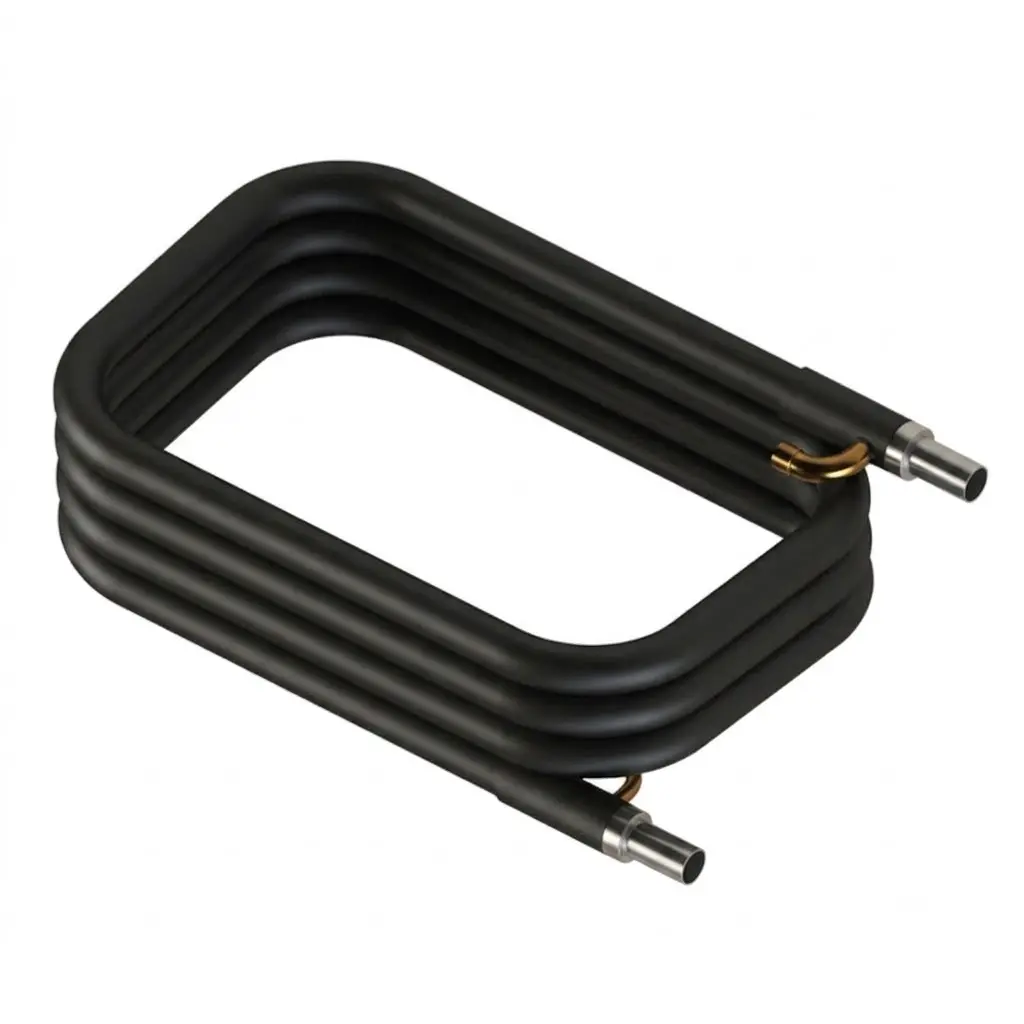
Titanium & Carbon Steel Coaxial Heat Exchanger (Marine-Grade Heavy Duty)
The Ultimate Seawater Thermal Solution
Engineered for high-salinity maritime and aquaculture environments, our Titanium-Carbon Steel Coaxial Heat Exchanger delivers the perfect balance of elite corrosion resistance and structural ruggedness. By utilizing premium pure titanium for the inner tube and heavy-duty carbon steel for the outer shell, this tube-in-tube heat exchanger is optimized for marine air conditioners, yacht refrigeration, and commercial seawater source heat pumps.
Why the “Titanium Inner + Carbon Steel Outer” Configuration?
- 100% Seawater Corrosion Immunity (Inner Tube): The water passway is constructed entirely from pure Titanium (Ti). Titanium naturally forms a highly stable, tightly adherent oxide film that provides absolute immunity to aggressive chlorine ions, salt spray, and pitting corrosion common in seawater ecosystems.
- High-Pressure Mechanical Strength (Outer Shell): The refrigerant flows through the annular space protected by a heavy-wall Carbon Steel (G) outer tube. Carbon steel provides the superior tensile strength and fatigue resistance required to handle modern high-pressure refrigerants like R410A under severe maritime vibrations.
- Smart Galvanic Isolation: Our advanced manufacturing process ensures flawless separation and sealing at the copper/brass connection joints, preventing any potential galvanic corrosion between the dissimilar metals.
Technical Parameters & Material Specification
| Component | Material Grade | Primary Function |
|---|---|---|
| Inner Tube (Fluid/Water Side) | Pure Titanium (Enhanced Spiral Grooved) | Direct seawater contact; anti-corrosion, anti-fouling, and 30% higher heat transfer. |
| Outer Shell (Refrigerant Side) | Heavy-Duty Carbon Steel (Steel / Seamless Options) | Withstands thermal alternating stress and high system pressures. |
Request a Quote & Engineering Support
Fast Support: Download Coaxial Selection Data Sheet
Get precise thermal calculations and dimensions for your HVAC, Heat Pump, or Cryogenic project.
📊 View Marine Titanium Coaxial Heat Exchanger Technical Specifications & Dimensions
| Model | Refrigerant | Water Flow Rate | Nominal Capacity | Connection OD (mm) | Physical Dimensions (mm) | |||||||||
|---|---|---|---|---|---|---|---|---|---|---|---|---|---|---|
| GPM | m³/h | Btu/h | kW | Refrig. Inlet | Refrig. Outlet | Water Conn. | Length | Width | Height | A | B | C | ||
| KAK-H100GTi-F | R410A | 2 | 0.45 | 10,000 | 2.9 | 12.7 | 9.52 | 14 | 320 | 205 | 63 | 182 | 50 | 40 |
| KAK-H125GTi-F | R410A | 3 | 0.68 | 15,000 | 4.4 | 12.7 | 9.52 | 18 | 340 | 262 | 73 | 237 | 50 | 48 |
| KAK-H150GTi-F | R410A | 4 | 0.91 | 20,000 | 5.9 | 12.7 | 9.52 | 19 | 345 | 270 | 82 | 242 | 50 | 54 |
| KAK-H200GTi-F | R410A | 5 | 1.14 | 25,000 | 7.3 | 12.7 | 9.52 | 22 | 390 | 245 | 92 | 213 | 50 | 60 |
| KAK-H250GTi-F | R410A | 6 | 1.36 | 30,000 | 8.8 | 12.7 | 9.52 | 22 | 390 | 283 | 92 | 251 | 50 | 60 |
| KAK-H500GTi-F | R410A | 12 | 2.73 | 60,000 | 17.6 | 16.0 | 12.70 | 25 | 500 | 313 | 138 | 276 | 50 | 101 |
| KAK-H600GTi-F | R410A | 15 | 3.41 | 75,000 | 22.0 | 19.0 | 12.70 | 30 | 615 | 326 | 169 | 283 | 60 | 126 |
| KAK-H750GTi-F | R410A | 18 | 4.09 | 90,000 | 26.4 | 19.0 | 12.70 | 35 | 625 | 410 | 179 | 360 | 60 | 129 |
Standard Testing Conditions (As Condenser): Seawater Inlet Temperature: 29.4°C (85°F) | Seawater Outlet Temperature: 35.0°C (95°F) | Condensing Temperature: 40.0°C (104°F).
Frequently Asked Questions (FAQ) & Project Guidance
1. Why do manufacturers use Carbon Steel instead of Titanium for the outer tube in marine applications?
In a standard marine condenser or seawater source heat pump setup, the highly corrosive seawater runs strictly inside the inner tube, while the clean, non-corrosive refrigerant flows through the outer tube. Utilizing heavy-duty Carbon Steel for the outer shell provides premium tensile strength and maximum pressure containment for modern refrigerants (like R410A) while keeping total engineering and equipment costs highly competitive for the buyer. It is the most robust, cost-effective, and industry-approved design globally.
2. How do we ensure the galvanic isolation between Titanium and other system metals?
Connecting dissimilar metals like titanium and copper can risk galvanic corrosion if not handled properly. At NINGBO FXT, we utilize an advanced, proprietary brazing and mechanical sealing process at the joint connections. By using specialized transition fittings and precise insulation barriers, we eliminate direct electrical contact between the titanium inner tube and the copper refrigerant lines, guaranteeing zero galvanic breakdown throughout the system’s lifespan.
3. Can you customize the footprint to fit compact boat air conditioners or tight equipment spaces?
Absolutely. Marine and yacht applications always face strict spatial limitations. We do not believe in one-size-fits-all. Simply request our Technical Selection Sheet, or send us your equipment dimension constraints. Our engineering team will run precise thermodynamic simulations and provide customized 3D CAD/PDF drawings within 24 hours to ensure a perfect drop-in fit for your specific system footprint.
4. What is your Minimum Order Quantity (MOQ) and production lead time?
Unlike rigid Tier-1 manufacturers that demand massive initial production runs, we offer flexible MOQ options to support global commercial projects, custom engineering validations, and specialized marine retrofits. Our standard production lead time is 10–15 days for regular configurations and 25–30 days for bespoke, complex custom designs.
5. What packaging standards do you use to prevent sea freight damages?
We guarantee safe arrival under harsh international logistics handling. Lightweight or compact single orders are packed in reinforced, tightly strapped industrial cartons. For bulk commercial orders, heavy industrial bundles, or multi-unit shipments, we secure products in premium, ISPM-15 compliant plywood cases that feature high ring crush and exceptional tear strength to survive sea and air freight humidity and vibrations.