
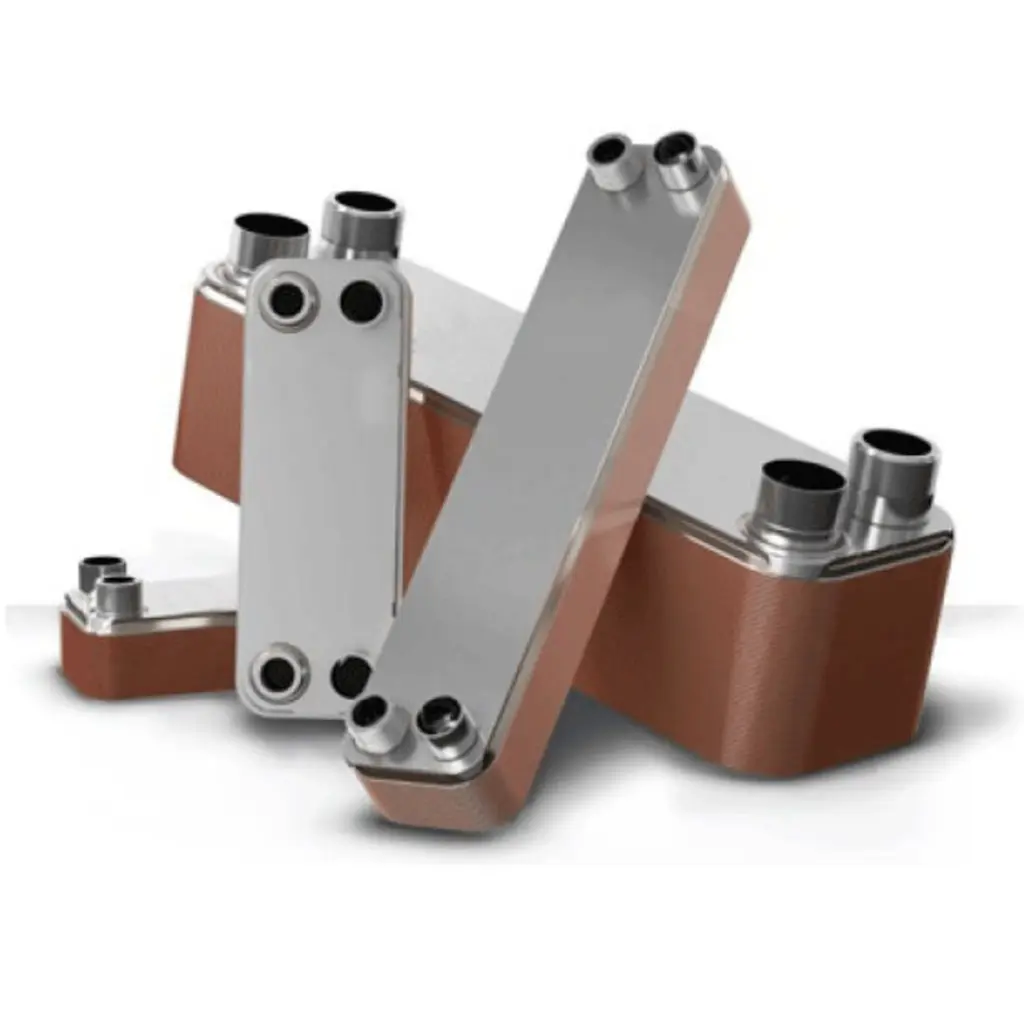
Brazed Plate Heat Exchanger (BPHE)
A brazed plate heat exchanger (BPHE) is a compact, high-efficiency heat transfer solution designed for liquid-to-liquid applications in HVAC/R, heat pumps, chillers, hot water systems, and industrial processes. It uses corrugated stainless steel plates brazed together (typically with copper) to create multiple flow channels, delivering excellent thermal performance while minimizing footprint.
Key Benefits
- High heat transfer efficiency: Turbulent flow across corrugated plates improves performance.
- Compact & lightweight: Saves space compared with shell-and-tube designs.
- Low refrigerant/medium volume: Helps reduce system charge and improves response.
- Reliable sealed construction: Brazed core design with no gaskets to maintain.
- Customizable: Plate count, port size, connection type, and flow arrangement available.
Typical Applications
- Heat pumps (water-to-water / brine-to-water)
- Chillers and liquid cooling systems
- Hydronic heating and domestic hot water systems
- Industrial cooling/heating loops and energy recovery
- Refrigeration systems (as condenser/evaporator depending on design)
Material & Configuration Options
- Plates: Stainless steel (commonly SS304/SS316)
- Brazing: Copper brazed (other options may be available by request)
- Connections: Copper stubs, stainless stubs, threaded, flange, or custom interfaces
- Flow arrangement: Counterflow / parallel flow (based on model selection)
To recommend the correct model, we typically confirm: working media, flow rate, inlet/outlet temperatures, pressure drop limits, operating pressure, and connection size/type.
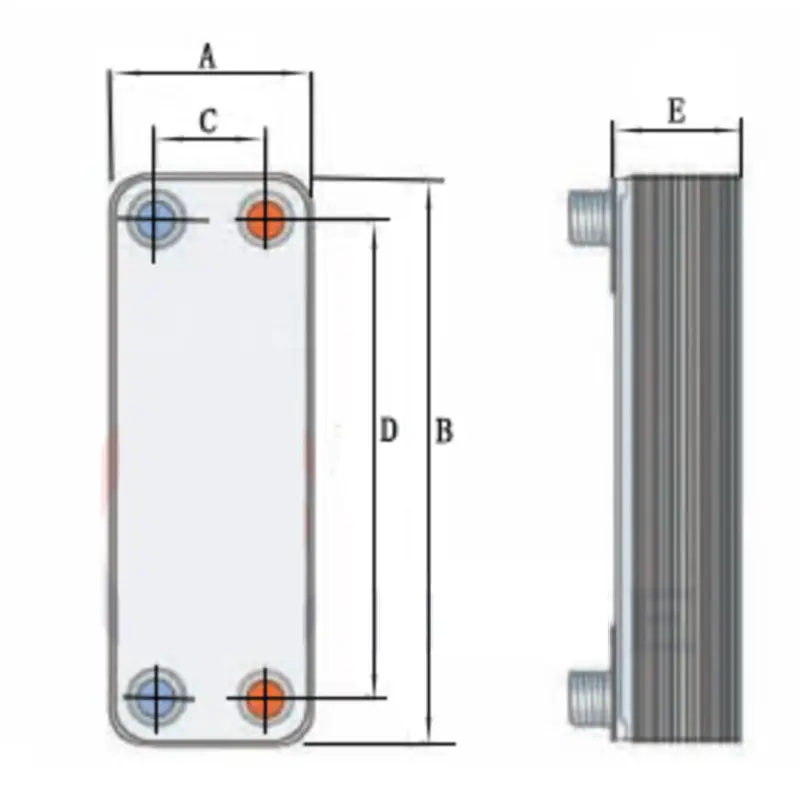
KAK Brazed Plate Heat Exchanger Specifications (BL14 – BL95)
| Model | Width A [mm] | Height B [mm] | Length E [mm] | Pitch C [mm] | Pitch D [mm] | Max. Pressure [MPa] | Max. Flow [m³/h] | Weight [kg] |
|---|---|---|---|---|---|---|---|---|
| BL14 | 78 | 206 | 9+2.3n | 42 | 172 | 3.0 | 3.6 | 0.6+0.06n |
| BL20 | 76 | 310 | 9+2.3n | 42 | 282 | 3.0 | 3.6 | 1.0+0.08n |
| BL26 | 111 | 310 | 10+2.36n | 50 | 250 | 3.0/4.5 | 8.1 | 1.3+0.12n |
| BL30 | 124 | 304 | 13+2.4n | 70 | 250 | 3.0 | 8.1 | 2.2+0.16n |
| BL50 | 111 | 525 | 10+2.35n | 50 | 466 | 3.0/4.5 | 12.7 | 2.6+0.19n |
| BL95 | 191 | 616 | 11+2.35n | 92 | 519 | 3.0/4.5 | 39.0 | 7.8+0.36n |
KAK Brazed Plate Heat Exchanger Specifications (BL120 – AY35)
| Model | Width A [mm] | Height B [mm] | Length E [mm] | Pitch C [mm] | Pitch D [mm] | Max. Pressure [MPa] | Max. Flow [m³/h] | Weight [kg] |
|---|---|---|---|---|---|---|---|---|
| BL120 | 246 | 528 | 13+2.36n | 174 | 456 | 3.0 | 42.0 | 7.2+0.52n |
| BL190 | 307 | 696 | 13+2.75n | 179 | 567 | 3.0 | 100.0 | 12.5+0.72n |
| BL200 | 321 | 738 | 13+2.7n | 188 | 603 | 2.1 | 100.0 | 13.0+0.75n |
| BL250 | 322 | 739 | 13+2.7n | 205.2 | 613.7 | 3.0/4.5 | 100.0 | 16.0+0.711n |
| BL300 | 370 | 995 | 11+2.675n | 213.5 | 861 | 3.0/4.5 | 200.0 | 21.0+1.26n |
| AY35 | 123 | 281 | 11+3.1n | 52 | 227 | 3.0 | – | 1.64+0.124n |
FAQ
1) What is a brazed plate heat exchanger used for?
BPHEs are used to transfer heat between two liquids efficiently in HVAC/R and industrial systems, such as heat pumps, chillers, hydronic heating, hot water production, and process cooling.
2) Can BPHE be used with refrigerants?
Yes. Many BPHE designs are used in refrigeration and heat pump systems. Model selection must match refrigerant type, operating pressure, and application (evaporator/condenser/double-wall requirements if applicable).
3) What information do you need to select a suitable model?
Please share the working media, flow rate, inlet/outlet temperatures (both sides), allowable pressure drop, operating pressure, and required connection size/type. If you have a drawing or current model reference, that helps.
4) Can you provide OEM/private labeling?
Yes. OEM options can include nameplate/label, packaging, port configuration, and customized specifications based on your application requirements.
5) How should a BPHE be installed?
Installation depends on the model and system design. In general, ensure correct flow direction, proper filtration, avoid vibration stress on ports, and follow recommended mounting practices. We can share installation guidance for the selected model.
6) How do you prevent clogging or fouling?
Use proper filtration/strainers, maintain water quality, and follow regular system maintenance. For high-fouling fluids, consider a design better suited for cleaning or specify a model with suitable channel geometry.
7) What certifications do your BPHEs carry?
Quality and safety are our top priorities. Our brazed plate heat exchangers are manufactured under strict quality management systems and carry major international approvals, including UL, CE, BV, DNV, and GL. Additionally, our facilities are ISO 9001 and ISO 14001 certified to ensure consistent performance and environmental responsibility.